The Birdcage, directed by Mike Nichols, possibly ranks as one of the greatest situational comedies out there. Based off the French film La Cage aux Folles, it explores the situation of this couple getting married where the fiancee has strongly Conservative parents part of the Keeley family. One of which is senator up for re-election. The Fiancee’s soon to be husband (Val) has a gay couple as his parents. In fear of how the Keeley family will respond, Val convinces his parents to act like a straight couple for a day, as the Keeley’s have arranged to visit for dinner. This idea doesn’t go down to well, coming with the immense difficulty and uncomfortable nature of trying to be someone they’re not after spending all those years discovering themselves.
It’s a messy situation that leads to a lot of conflict between the gay couple played by both Robin Williams and Nathan Lane. Many of us still still feel the need to act like someone else in order to be accepted by curtain groups of people, and it can be a very distressing situation that causes a lot of strain. In this respect it’s a trainwreck that many can relate to, executed in a comedic fashion by some of the best comedians of that time. It was one of the first LGBTQ films to receive the number 1 spot in the box office, which it maintained for three consecutive weeks. For its time, where there was still a fairly large homophobic community, this was considered a massive achievement. The film exposed a moral that around self acceptance that many had failed to consider, with a very fun and playful approach.
What Val persuades his parents to do is really horrible and inconsiderate. Yet the film neither condemns or justifies his actions, but the toll it has on them is clearly established. Seeing the couple act like different people never feels right, and it’s something that even the Senator unconsciously notices himself. Once he finds out the truth, there is some sort of acceptance formed through the way he interacts with them. This does lead to the Keeley family participating in the marriage by the end. Although we don’t see the development that causes this arrangement to become a reality, it is clear that they’ve come to accept them for who they are.
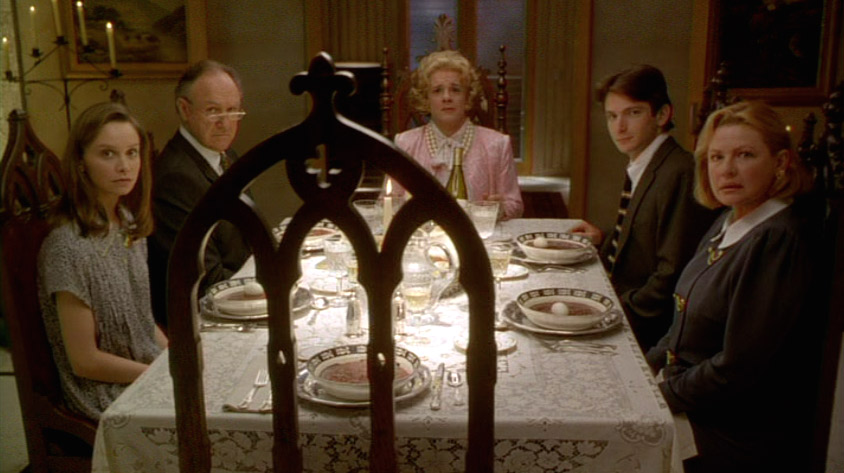
In order for the film to maintain its wide appeal, it used the established political stereotypes as its main source for comedic material. Both the conservative family and the gay couple are stereotypes over-exaggerated to a degree that it’s hard to take remotely seriously. As these stereotypes have become less common in the media, and a larger portion of society have stopped perceiving a gay persons personality as this set representation, criticism has been directed towards the films over-reliance on stereotypes due to the perceived beliefs they can form towards the gay community. As someone who identifies as being bisexual, I personally still don’t mind it and am by no means offended by it, as the stereotypical constructs are there to support the moral of the film. The comedic genius of it all would not be so on point if it wasn’t for the stereotypes. It’s definitely a film of its time that would not work in this time of age, but for 1996 this was an incredibly progressive approach that exposed people to morals that they needed to be shown. It still exposes the discomfort of having to act like someone you’re not in a way that no other film has done before.
As a political satire, this film still works perfectly due to the unbelievably hilarious performances by the entire cast. The script itself is great, but its really what the actors do with the material that makes it work so well. Like most great film Directors, Mike Nichols made them do the first few takes following the script until he was satisfied, and then let the actors do their own improvised takes. This approach seemed to have worked perfectly for this film. Seeing the gay couple (Armand and Albert) act in the way they perceive is ‘playing it straight’ is one of the funniest things imaginable. The way the Senator wrongly suspects what’s going on with the family, and can’t even comprehend the reality makes for a great final act. It’s all overreacted and stereotyped. It’s knows it. It embraces it. And I love it.
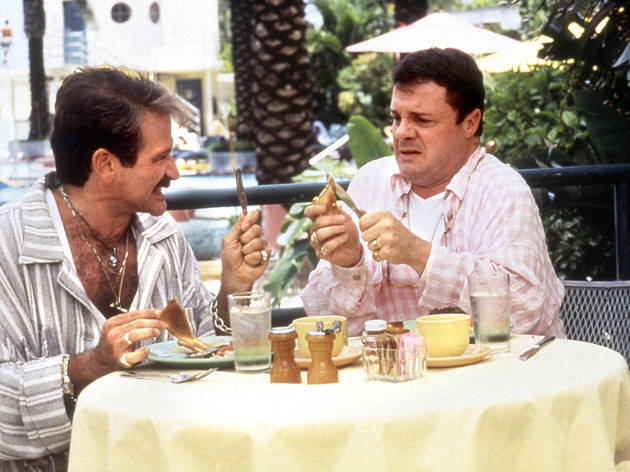
The casting couldn’t have been better. Every actor fits their role perfectly and has their own valuable contribution to the material. Even the smaller characters like Hank Azaria’s role as Agador play an amazing contribution to the film. It was a career high for all of them, especially Robin Williams and Nathan Lane, who had some of the best comedic chemistry I’ve ever seen from a film. Its sad we didn’t get to see more films with them working together. Gene Hackman’s role also can’t be forgotten. This is by far my favorite performance of his.
Overall, despite this being a film of its time, it still holds and incredibly important place in my heart. As someone who only just came out as bisexual, there is still lots of people I still hide that from. Hiding that side of myself can hurt and often just doesn’t feel right. This film explores what it feels like in such a comedic and playful manner that not just makes me happier, but more confident to embrace who I am as a person.

 Cinema Impact